
• Home
    • Safety
    • Sitemap (en)
    • Mazda 6
    • Nissan Almera
    • Renault Sandero
    • Renault Arkana
    • Renault Megane 2
    • Renault Logan
    • Duster
    • GAZELLE NEXT
    • Solaris
    • UAZ car
    • Kia Magentis
  • Engines
  • transmission
  • Search

Select your language

  • 正體中文
  • French (fr-FR)
  • Беларуская (Беларусь)
  • Deutsch (Deutschland)
  • Russian (ru-RU)
  • Українська (Україна)
  • Қазақша (kk-KZ)
  • English (UK)
  • Español (España)

Repair Renault Megane-2

Renault Megane II

The Renault Megane II, produced from 2003 to 2008 in France, Turkey, and Spain, complies with European Euro 4 emissions standards.

The car was equipped with 1.4 L (K4J), 1.6 L (K4M), and 2.0 L (F4R) petrol engines, and a 1.5 L dCi diesel engine (K9K Turbo).

The cars were produced with front-wheel drive, with a 5- or 6-speed manual or 4-speed automatic transmission.

The body is all-metal, a load-bearing structure, and can be a four-door sedan, five-door station wagon, or hatchback.

In In 2006, the model underwent a minor restyling, which resulted in changes to the bumpers, radiator grille, and headlights.

The car was supplied to Russia in the following basic trim levels: Authentique, Sportway, Confort, Expression, ExTReme, Privilege, Dynamique, and Business.

Renault Megane II Coolant Replacement

General requirements for the cooling system

Important! When performing work requiring complete draining of the fluid from the cooling system, always rinse the system with clean water and blow it through with compressed air to remove water residues.

Fill with coolant, remove the air from the system and measure its actual frost resistance. The system must ensure frost resistance:

  • at a temperature down to –25 °C ± 2 for countries with a cold and temperate climate;
  • at a temperature down to –40 °C ± 2 for countries with a very cold climate.

Precautions: before starting the work, cover the electrical equipment devices with plastic bags.

Replacing the coolant

Replacement interval: as recommended by the manufacturer, the coolant should be replaced after 6 years of operation or 90 000 km of mileage, whichever comes first.

Necessary materials and tools

  • coolant — use GLACEOL RX (type D);
  • clean cloth;
  • container for draining the coolant with a volume of at least 10 litres;
  • pliers.

Important! The coolant must be replaced with the engine cold.

Procedure

We place the vehicle on a lift or over an inspection pit.
Vehicle on the lift
We place the vehicle on a lift or over an inspection pit

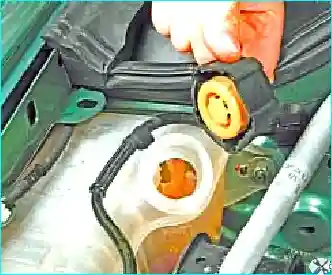
We open the expansion tank cap. We remove the engine undertray and the engine splash guard.
Removing the undertray and splash guard
We remove the engine undertray and the engine splash guard
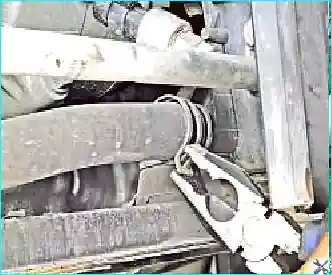
Squeezing the clip ears of the expansion tank hose
We squeeze the clip ears of the expansion tank supply hose securing clip and slide the clip along the hose

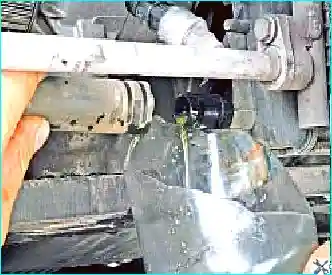
We remove the hose from the radiator stub and drain the fluid into the container placed underneath. After the coolant has finished draining, we refit the hose onto the stub.
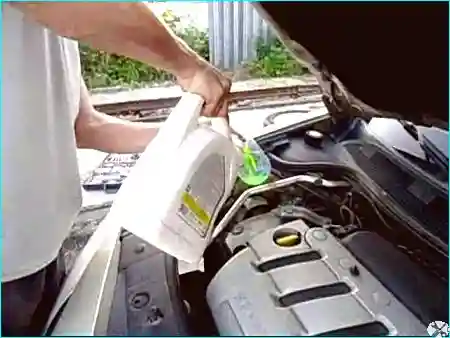
Pouring the coolant into the expansion tank
We pour the fluid into the expansion tank up to the «max» mark on the tank wall

Removing air locks

We start the engine and warm it up to operating temperature (until the fan switches on). After that we stop the engine and check the coolant level. If necessary, we top it up in the expansion tank to the «max» mark.

Temperature monitoring: while the engine is running, the coolant temperature must be monitored using the gauge.

If the gauge has reached the overheating zone but the radiator fan has not switched on:

  • switch on the heater and check what air passes through it;
  • if the heater supplies warmed air — the fan is most likely faulty;
  • if it supplies cold air — an air lock has formed in the engine cooling system.

To remove the air lock:

  1. We switch off the engine and let it cool down.
  2. We unscrew the filler neck cap.
  3. We start the engine and let it run for 3–5 minutes.
  4. We close the filler neck cap.

Tip: for better filling of the system without air locks, the radiator hoses should be periodically squeezed by hand.

After replacement: a few days after operating the vehicle following the coolant replacement, its level must be checked. If necessary, we top up the fluid.


Additional information: Method of replacing the coolant on a Renault Megane 2

  1. Removing the intake and exhaust manifolds on the Renault Megane IIм
  2. Renault Megane II body structure
  3. Removing Renault Megane II seat belts
  4. Renault Megane II passive safety system
  5. Renault Megane II compressor drive repair
  6. Removing the Renault Megane II exterior mirror
  7. Removing the seats of a Renault Megane II
  8. Renault Megane II trunk repair
  9. Disassembly of the Renault Megane II rear door
  10. Disassembly of the Renault Megane II front door
  11. Removing Renault Megane II hood components
  12. Renault Megane II front fender replacement
  13. Removing the wheel arch liners on a Renault Megane II
  14. Removing the rear bumper of a Renault Megane II
  15. Renault Megane II starter repair
  16. Removal of the Renault Megane II electronic control unit
  17. Renault Megane II Gear Shift Linkage Replacement
  18. Renault Megane II Gearbox Cable Replacement
  19. Removing the subframe of a Renault Megane II
  • 17
  • 18
  • 19
  • 20
  • 21
  • 22
  • 23
  • 24
  • 25
  • 26